5 Emerging Technologies That Will Change How We Work by 2026
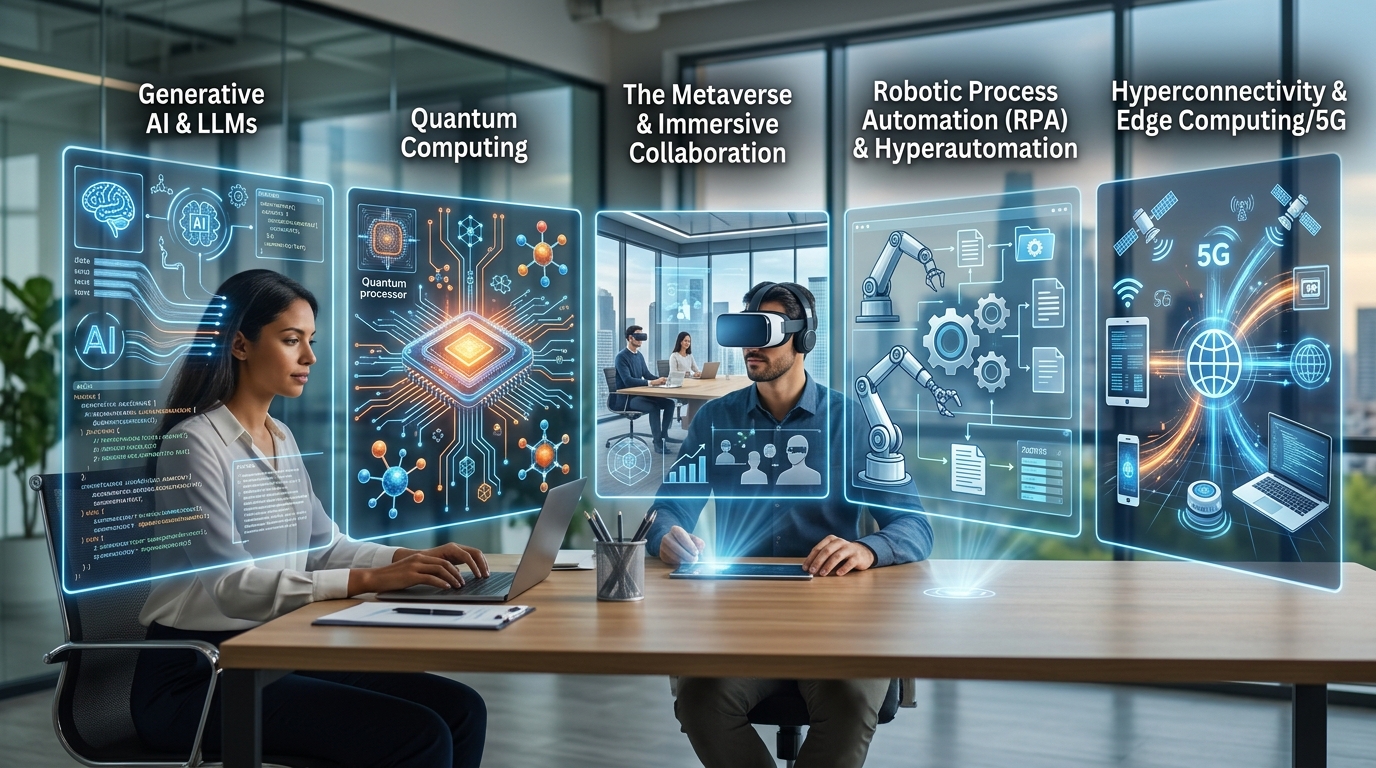
The workplace you step into tomorrow will look nothing like the one you left today. Technology isn’t just changing how we work anymore. It’s redefining what work means entirely. By 2026, five breakthrough technologies will reshape everything from your morning standup to your career trajectory. Some are already here in early forms. Others are about to explode into the mainstream. Either way, understanding them now gives you a massive advantage.
Five emerging technologies 2026 will mainstream include generative AI assistants, spatial computing interfaces, ambient intelligence systems, quantum-ready security, and neural interface devices. These innovations will transform workplace collaboration, decision-making, security protocols, and how we interact with digital systems. Business professionals who understand and adopt these technologies early will gain significant competitive advantages in their careers and organizations.
Generative AI Assistants Move Beyond Chatbots
Generative AI in 2026 won’t just answer questions. It will anticipate needs, draft documents, and make decisions within defined parameters.
Think of it as having a colleague who never sleeps, never forgets, and processes information at superhuman speed. These assistants will attend meetings, take notes, identify action items, and even suggest strategic approaches based on historical data.
The technology already exists in primitive forms. What changes by 2026 is reliability and integration depth. These systems will understand context across multiple platforms, remember conversations from months ago, and adapt their communication style to match yours.
How this changes your workday:
- Morning briefings customized to your role and current projects
- Real-time fact-checking during presentations and meetings
- Automated first drafts of reports, emails, and proposals
- Predictive scheduling that accounts for energy levels and task complexity
- Cross-platform data synthesis without manual input
The shift isn’t about replacing human judgment. It’s about freeing professionals from repetitive cognitive tasks so they can focus on strategy, creativity, and relationship building.
“The professionals who thrive in 2026 won’t be those who resist AI assistance. They’ll be the ones who learn to collaborate with these systems effectively, treating them as force multipliers rather than threats.”
Spatial Computing Replaces Flat Screens
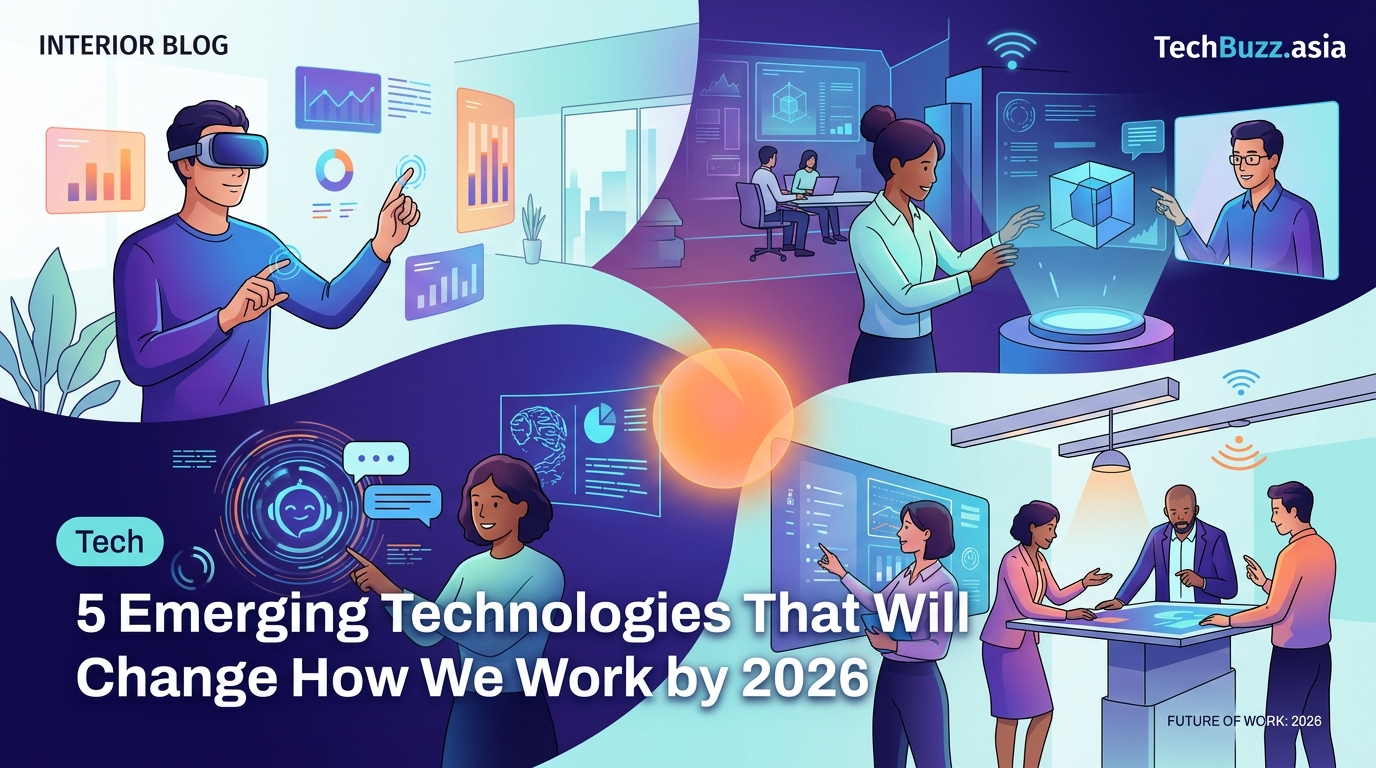
Your monitor is about to become obsolete. Spatial computing brings digital content into three-dimensional space around you.
This isn’t virtual reality in the clunky headset sense. By 2026, lightweight glasses or contact lenses will overlay digital information onto your physical environment. You’ll manipulate data with hand gestures, eye movements, and voice commands.
Meetings will transform completely. Instead of staring at gallery view on a screen, remote colleagues will appear as life-sized holograms in your conference room. You’ll collaborate on 3D models, architectural plans, and data visualizations that float in shared space.
Practical Applications Already Taking Shape
| Use Case | Traditional Method | Spatial Computing Approach |
|---|---|---|
| Product Design Review | 2D images on screen | Full-scale 3D models you walk around |
| Data Analysis | Spreadsheets and charts | Interactive visualizations in space |
| Remote Collaboration | Video calls | Holographic presence with shared objects |
| Training Programs | Manuals and videos | Hands-on simulation in safe environment |
| Client Presentations | Slide decks | Immersive experiences clients step into |
The learning curve will be steeper than adopting smartphones. But the productivity gains make it worthwhile. Professionals who master spatial interfaces early will have a significant edge.
Some industries will adopt faster than others. Architecture, engineering, medicine, and design fields are already testing these systems. By 2026, they’ll be standard tools.
If you work with complex data, visual information, or remote teams, start preparing now. The transition is coming whether you’re ready or not.
Ambient Intelligence Makes Workspaces Responsive
Your office will start paying attention to you. Ambient intelligence embeds sensors and AI throughout physical spaces to create environments that adapt automatically.
Walk into a conference room and the lighting adjusts to your preference. The temperature shifts based on occupancy and individual comfort data. Your calendar appears on the nearest surface. Background noise from the hallway disappears thanks to directional sound cancellation.
This goes far beyond smart thermostats. Ambient intelligence systems learn patterns, predict needs, and optimize environments for productivity without conscious input.
What ambient intelligence handles automatically:
- Lighting levels that match circadian rhythms and task requirements
- Air quality monitoring with real-time ventilation adjustments
- Noise management using adaptive acoustic dampening
- Equipment preparation before meetings start
- Privacy controls that activate when sensitive conversations begin
- Energy optimization that reduces waste without sacrificing comfort
The technology feels invisible because it works in the background. You only notice when you’re in a space without it.
Privacy concerns are legitimate. These systems collect enormous amounts of behavioral data. Companies implementing ambient intelligence need clear policies about data usage, storage, and employee consent.
Done right, ambient intelligence reduces cognitive load. You stop thinking about environmental adjustments and focus entirely on your work. Done wrong, it creates surveillance nightmares.
The difference lies in implementation philosophy. Systems designed to serve employees feel helpful. Systems designed to monitor employees feel oppressive.
Quantum-Ready Security Becomes Standard
Current encryption methods will break when quantum computers reach maturity. That’s not a distant threat anymore. It’s a 2026 problem.
Quantum-ready security doesn’t require quantum computers to implement. It means adopting encryption algorithms that quantum computers can’t crack. Organizations are rolling out these systems now to protect data that needs to stay secure for years.
For business professionals, this means password protocols will change dramatically. Biometric authentication becomes standard. Multi-factor systems get more sophisticated. Zero-trust architectures replace traditional network security.
You won’t need to understand the mathematics. But you will need to follow new security procedures that feel more complex initially.
The Security Transition Timeline
The shift happens in phases. Early adopters are already testing quantum-resistant algorithms. By mid-2026, most enterprise systems will require them. Laggards will face increasing vulnerability as quantum computing advances.
Financial services, healthcare, and government sectors are moving fastest. They handle the most sensitive data and face the strictest regulations. Other industries will follow their lead.
Personal devices will update automatically for most users. But workplace systems require active migration. IT departments are already planning these transitions. Employees need to prepare for new authentication methods and security protocols.
The good news is that quantum-ready security often improves user experience. Biometric systems are faster than typing passwords. Adaptive authentication reduces friction for routine tasks while increasing protection for sensitive operations.
Understanding these changes helps you adapt faster when your organization makes the switch. If you’re involved in security decisions, start conversations now. Waiting until 2026 means playing catch-up under pressure.
Neural Interface Devices Enter Professional Use
Controlling computers with your thoughts sounds like science fiction. But neural interface technology is already FDA-approved for medical applications. By 2026, professional versions will be available for workplace use.
These aren’t brain implants for most users. They’re headbands, earbuds, or glasses that read electrical signals from your brain. The technology detects focus levels, emotional states, and simple commands.
Initial applications focus on accessibility and productivity monitoring. People with mobility limitations can control devices through thought alone. Professionals can track their cognitive state to optimize work schedules.
More controversial uses involve attention monitoring. Some systems alert you when focus drops during important tasks. Others provide managers with aggregate data about team cognitive load.
The ethical implications are massive. Neural data is the most personal information imaginable. Regulations are still catching up to the technology.
Current neural interface capabilities:
- Focus level detection with 85% accuracy
- Basic command input for device control
- Emotional state recognition for wellness monitoring
- Attention tracking during meetings and presentations
- Cognitive load measurement for task optimization
The technology improves rapidly. What works at 85% accuracy today will hit 95% by 2026. That crosses the threshold from interesting experiment to reliable tool.
Early adopters will be knowledge workers who benefit most from optimized cognitive performance. Writers, programmers, analysts, and designers are already testing these devices.
Mainstream adoption depends on proving clear benefits without creating surveillance concerns. Companies that implement neural interfaces transparently, with strong privacy protections, will see positive results. Those that use them for heavy-handed monitoring will face backlash.
For professionals considering these tools, the decision comes down to personal comfort with brain data collection. The productivity gains are real. So are the privacy risks.
Preparing Your Career for Technology Shifts
Understanding emerging technologies 2026 will bring matters less than knowing how to position yourself for success.
Start by identifying which technologies impact your industry most directly. Designers should focus on spatial computing. Analysts need to master AI collaboration. Security professionals must understand quantum-ready systems.
Build hands-on experience now with early versions of these technologies. Most have accessible entry points. Generative AI tools are widely available. Spatial computing demos exist in many cities. Ambient intelligence shows up in smart home devices.
The goal isn’t becoming a technical expert. It’s developing comfort and fluency so you’re not starting from zero when these systems become standard in your workplace.
Network with early adopters. Join communities testing these technologies. Read case studies from industries ahead of yours. The patterns that work in architecture today might apply to your field tomorrow.
Consider how these technologies change your role specifically. Will AI assistants handle tasks you currently do manually? Will spatial interfaces make certain skills more valuable? Will ambient intelligence change where and how you work?
Proactive adaptation beats reactive scrambling. The professionals who thrive through technological transitions are those who see changes coming and position themselves accordingly.
Some skills become more valuable as technology advances. Critical thinking, creative problem-solving, emotional intelligence, and strategic communication all increase in importance. These are things machines still can’t replicate effectively.
Technical fluency matters, but human skills matter more. The sweet spot is professionals who combine both. They understand technology well enough to use it effectively while bringing uniquely human capabilities to their work.
If you’re feeling overwhelmed, start small. Pick one technology from this list. Spend 30 minutes each week learning about it. Try available tools. Read implementation stories. Talk to people using it professionally.
Small, consistent exposure builds familiarity. When these technologies arrive in your workplace, you’ll be ready to adopt them confidently rather than resisting out of discomfort.
Your Workplace Is Already Changing
These five technologies aren’t distant possibilities. They’re active developments with clear trajectories toward mainstream adoption by 2026.
Some will arrive faster than expected. Others might take slightly longer. But the direction is set. Spatial computing, generative AI, ambient intelligence, quantum-ready security, and neural interfaces will reshape professional work within the next few years.
The question isn’t whether these changes will happen. It’s whether you’ll be ready when they do. Start building familiarity now. Test available tools. Follow developments in your industry. Connect with professionals already using these technologies.
The future of work isn’t something that happens to you. It’s something you can actively prepare for and shape. Understanding emerging technologies 2026 will mainstream gives you that opportunity. Take it seriously, and you’ll be positioned to thrive through the transition rather than struggle to catch up.


Post Comment