Why Console Gamers Are Finally Making the Switch to PC Gaming
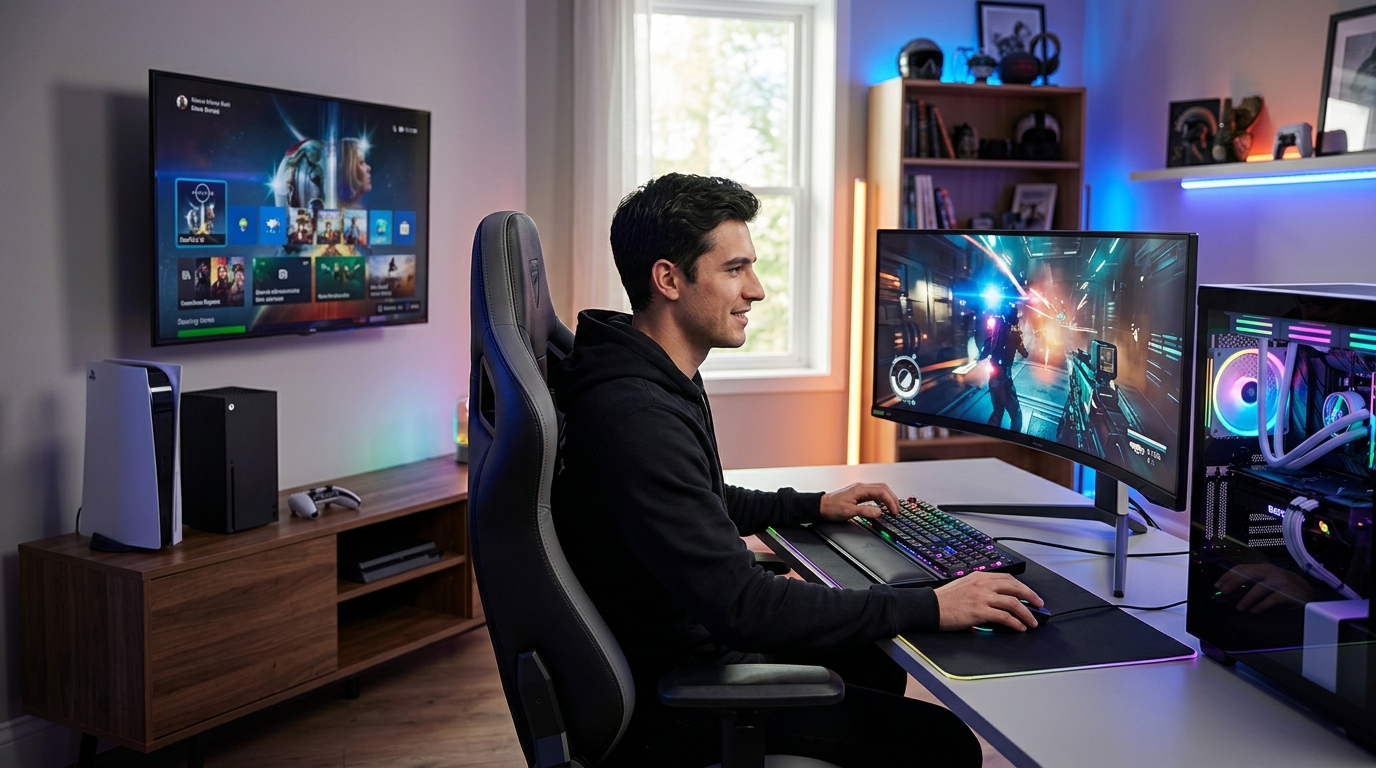
You’ve spent years on PlayStation or Xbox. Your controller feels like home. But lately, you’ve been noticing what PC gamers have been talking about for years.
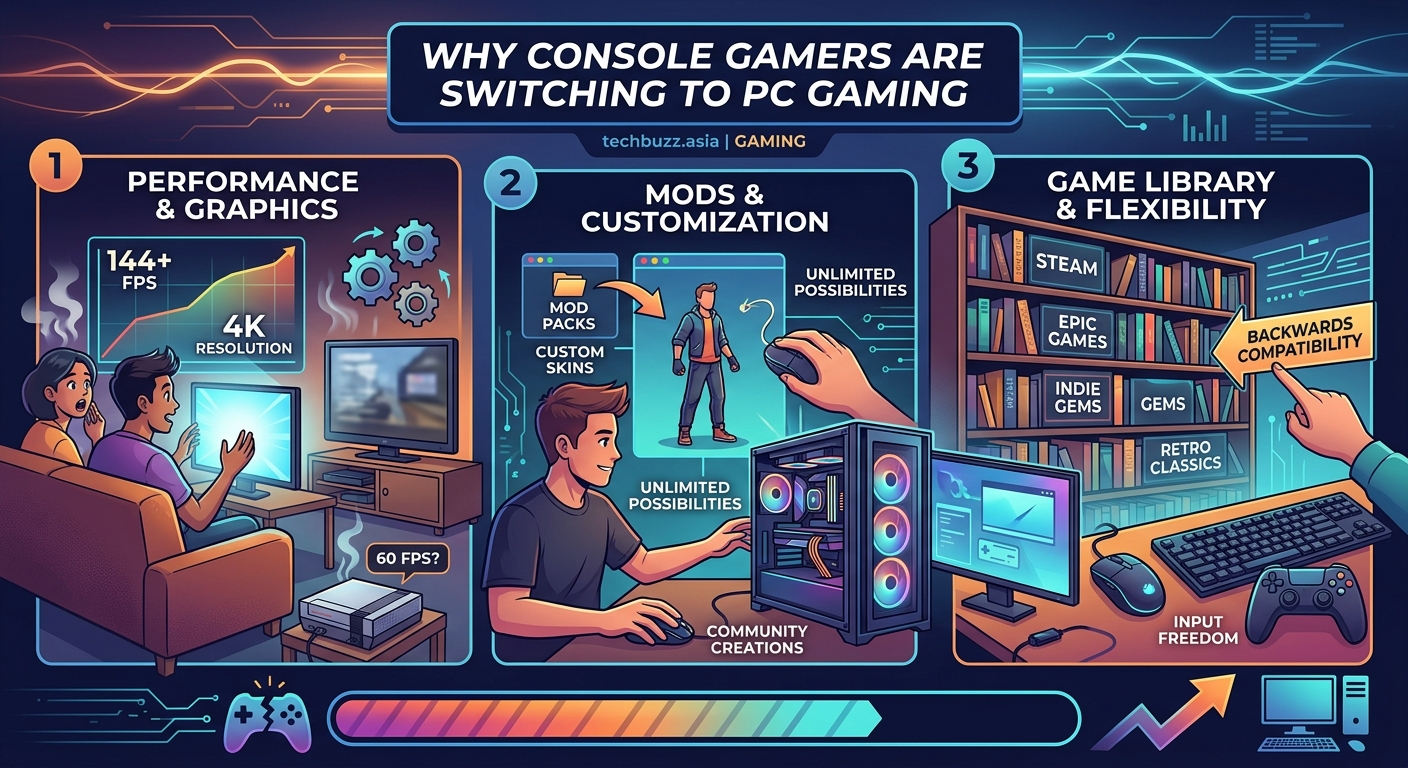
Higher frame rates. Mod support. Steam sales that make your wallet happy. The ability to upgrade instead of waiting for the next console generation. These aren’t just talking points anymore. They’re real advantages that are harder to ignore as console hardware ages and game prices climb.
Switching from console to PC offers superior performance, lower long-term costs, backward compatibility across decades of games, free online multiplayer, extensive customization options, and access to exclusive titles and mods. While the initial investment is higher, PC gaming provides better value over time with cheaper games, upgradeable hardware, and multi-purpose functionality beyond gaming alone.
Performance That Actually Matches What Developers Promise
Console marketing loves to throw around buzzwords like “4K” and “120fps.” The reality is more complicated.
Most console games use dynamic resolution scaling. That means your game drops to 1440p or lower when the action gets intense. You paid for 4K, but you’re not always getting it.
PC gaming gives you control. Want to lock your frame rate at 144fps? Done. Prefer maximum visual fidelity at 60fps? Your choice. The hardware doesn’t make decisions for you.
Modern GPUs like the RTX 4070 or AMD’s 7800 XT deliver consistent performance that exceeds what current consoles can manage. You’re not waiting for “performance mode” patches or choosing between visual quality and smooth gameplay.
The Real Cost of Console Gaming Nobody Talks About
Let’s do some math that console manufacturers hope you won’t.
PlayStation Plus Premium costs $160 per year. Xbox Game Pass Ultimate runs $204 annually. Over a console generation (roughly seven years), that’s $1,120 to $1,428 just for the privilege of playing online.
PC gamers pay zero for online multiplayer.
Then there are game prices. New console releases sit at $70. That same game on PC? Often $60, and it goes on sale faster and deeper. Steam sales regularly offer 50-75% discounts within months of release. Console sales rarely match that.
A $1,200 gaming PC looks expensive until you factor in five years of subscription fees and higher game costs. The math shifts dramatically in PC’s favor.
Backward Compatibility That Actually Works
Your PS5 plays most PS4 games. That’s nice. Your Xbox Series X handles some Xbox One titles. Better than nothing.
PC plays games from 1995 if you want it to. No “remaster” required. No waiting for Sony to add your favorite game to their streaming service.
I still boot up the original Deus Ex from 2000. It runs on Windows 11 without issues. Try playing your PS3 library on your PS5. You can’t, unless you subscribe to PlayStation Plus Premium and stream it with input lag.
PC gaming respects your library. When you buy a game on Steam, GOG, or Epic, it’s yours. Forever. Across multiple hardware upgrades. No generation boundaries.
Freedom to Play How You Want
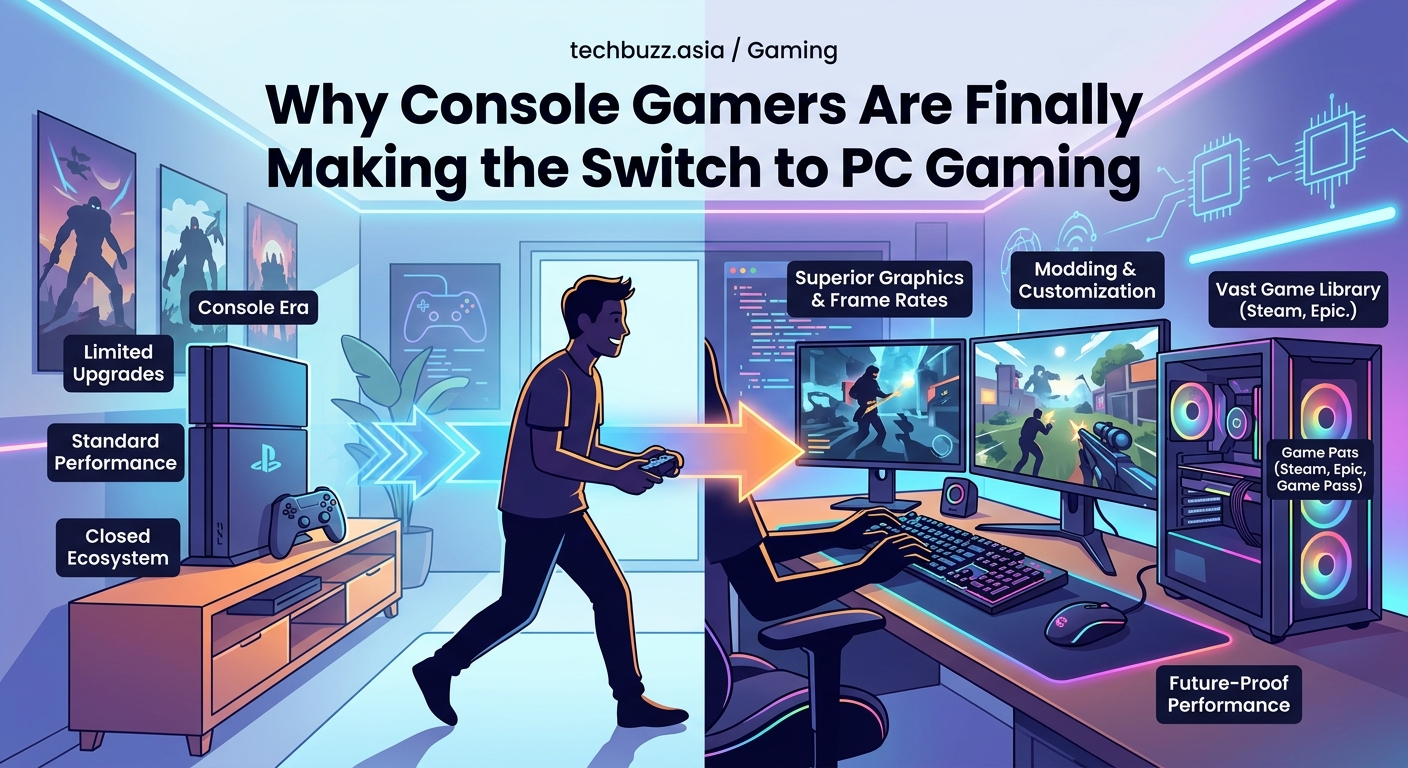
Consoles lock you into their ecosystem. Sony wants you buying from the PlayStation Store. Microsoft pushes Game Pass. You play by their rules.
PC gaming offers actual choice:
- Use a PlayStation controller, Xbox controller, or mouse and keyboard
- Buy games from Steam, Epic, GOG, Humble Bundle, or direct from developers
- Install mods that fix bugs, add content, or completely overhaul games
- Adjust graphics settings for your preferences, not Sony’s decisions
- Play at any refresh rate your monitor supports
- Use multiple monitors for racing sims or flight games
Console gaming feels restrictive once you’ve experienced PC flexibility. Going back is like switching from a smartphone to a flip phone.
Games That Never Come to Console
Some of the best gaming experiences exist only on PC. Not because of exclusivity deals, but because consoles can’t handle them.
Strategy games like Civilization VI work better with mouse and keyboard. MMOs like Final Fantasy XIV perform better on PC with higher frame rates and faster loading. Indie titles often launch on PC first, sometimes exclusively.
Then there’s the mod community. Skyrim on console gets a handful of approved mods. Skyrim on PC has over 70,000 mods that transform the game into something unrecognizable. Bethesda games become ten times better with community fixes and content.
Simulation games barely exist on console. Cities: Skylines, Microsoft Flight Simulator, and Euro Truck Simulator all shine on PC. Console versions are watered-down compromises.
Your First Steps Toward PC Gaming
Making the switch doesn’t require a computer science degree. Here’s your roadmap:
- Set a realistic budget that includes monitor, keyboard, and mouse if you don’t have them
- Research current GPU and CPU options within your price range using sites like PCPartPicker
- Decide whether to build or buy prebuilt based on your comfort level with hardware
- Start with one or two games you already own on console to compare performance
- Join PC gaming communities on Reddit or Discord for troubleshooting help
- Gradually build your Steam library during seasonal sales
Building your own PC saves money and teaches you how everything works. Prebuilts cost more but eliminate the learning curve. Both are valid choices. Building your first gaming PC has become easier than ever with modern components.
Common Worries That Stop Console Gamers
Let’s address the fears keeping you on console.
“PC gaming is too expensive.” The upfront cost is higher. The long-term cost is lower. You’re not paying for online play. Games cost less. You can upgrade parts instead of buying entirely new hardware every seven years.
“I don’t know how to build a PC.” You don’t have to. Prebuilts exist. Or watch a single YouTube tutorial. Building a PC is like adult Lego. Everything only fits one way.
“My friends are on console.” More games support crossplay every month. Call of Duty, Fortnite, Rocket League, Apex Legends, and dozens more let you party up across platforms. You’re not abandoning your friends.
“I’ll spend all my time fixing problems instead of playing.” This hasn’t been true since 2015. Modern PC gaming is plug and play. Windows 11 optimization takes ten minutes and you’re done.
“Controllers are better for gaming.” Use a controller on PC. Problem solved. Every modern game supports Xbox and PlayStation controllers natively.
The Technical Advantages That Matter
Beyond frame rates and resolution, PC gaming offers technical benefits that improve your actual experience.
Loading times disappear with NVMe SSDs. Console SSDs are fast. PC SSDs are faster, and you can install multiple drives without paying Sony’s markup for proprietary expansion cards.
Input lag drops to imperceptible levels. Console gaming adds multiple frames of delay between your button press and on-screen action. Competitive gamers notice. Casual gamers feel something is off without knowing why.
Audio quality improves dramatically with proper sound cards or DACs. Console audio is compressed and limited. PC audio supports lossless formats and spatial audio without artificial restrictions.
Streaming and content creation become simple. OBS, Streamlabs, and other tools offer more control than console streaming ever will. If you’ve thought about creating gaming content, PC removes the technical barriers.
What You Gain Beyond Gaming
Here’s something console marketing never mentions. Your gaming PC does everything else too.
Video editing. 3D rendering. Programming. Music production. Photo editing. Streaming. Working from home. Your $1,200 gaming PC replaces a $800 work laptop.
Consoles play games and stream Netflix. That’s it. You can’t install Photoshop on a PlayStation. You can’t edit videos on an Xbox. You can’t run a side business on console hardware.
The value proposition changes completely when you factor in multi-purpose use. You’re not just buying a gaming machine. You’re buying a complete creative workstation that happens to play games better than dedicated gaming hardware.
Understanding the Upgrade Path
Console generations force complete replacements. Your PS4 became obsolete when the PS5 launched. Your entire investment reset to zero.
PC upgrades are gradual and optional. Your GPU struggles with new games? Replace just the GPU. Keep everything else. Spend $400 instead of $500 for an entirely new console.
Three years later, your CPU shows its age. Upgrade the CPU and motherboard. Keep the GPU, storage, case, and power supply. Spend $300 instead of buying the inevitable PS5 Pro.
This matters more than people realize. Console gaming is a subscription model disguised as hardware purchases. PC gaming lets you invest incrementally based on your needs and budget.
The Software Ecosystem Makes the Difference
Steam isn’t just a store. It’s a platform that respects you as a customer.
Refunds within two hours of play, no questions asked. Family sharing that actually works. Cloud saves across devices. A robust review system that warns you about broken games. Frequent sales that make gaming affordable.
Compare that to console stores. PlayStation’s refund policy is hostile. Xbox’s isn’t much better. Sales are infrequent and shallow. You’re locked into whatever Sony or Microsoft decides is fair.
Then there’s Steam’s hidden features that improve your gaming life. Remote play. Steam Input for controller customization. Proton for running Windows games on Linux. Big Picture mode for couch gaming.
The software experience matters as much as the hardware. PC gaming treats you like an adult who owns their purchases. Console gaming treats you like a renter who should be grateful for access.
What the Numbers Actually Show
Let’s break down real costs over five years of gaming.
| Expense Category | Console Gaming | PC Gaming |
|---|---|---|
| Hardware | $500 (console) | $1,200 (gaming PC) |
| Online subscription | $800 (PS Plus) | $0 |
| 20 new games | $1,400 ($70 each) | $1,000 ($50 average) |
| Peripherals | $120 (extra controller, headset) | $200 (keyboard, mouse, headset) |
| Total | $2,820 | $2,400 |
PC gaming costs less over five years. And that’s before factoring in free games from Epic, Humble Choice subscriptions, or bundle deals that console gamers never see.
The numbers get worse for console gamers who buy mid-generation upgrades like the PS5 Pro. Add another $500 to the console column. PC gamers might upgrade their GPU for $400 and still come out ahead.
Making the Transition Smooth
You don’t have to abandon console gaming overnight. Plenty of gamers keep both.
Start by identifying which games you play most. Competitive shooters? Those benefit most from PC’s higher refresh rates and lower input lag. Single-player story games? Less urgent to switch, but mods make them better.
Buy your PC during holiday sales. Black Friday and Amazon Prime Day offer significant discounts on components and prebuilts. Patience saves hundreds of dollars.
Transfer your skills gradually. Keep playing casual games on console while you adjust to mouse and keyboard for competitive titles. Or use your console controller on PC. There’s no rule saying you have to switch input methods.
Your console doesn’t become worthless. It’s still great for couch gaming and exclusives. But over time, you’ll notice yourself reaching for the PC more often. Better performance, cheaper games, and more control become addictive.
“I spent fifteen years on Xbox. Made the switch to PC in 2024 and immediately wondered why I waited so long. The performance difference in competitive games is night and day. I’m never going back.” – Former Xbox player on Reddit’s r/pcgaming
Why This Matters More in 2026
The gap between console and PC is widening, not shrinking.
Current-gen consoles launched in 2020. They’re already showing their age. Games target 30fps for visual showcases. “Performance modes” sacrifice visual quality for 60fps. True 4K gaming remains rare.
Meanwhile, PC hardware continues advancing. The RTX 5000 series and AMD’s RDNA 4 cards push boundaries that consoles won’t reach until 2028 at the earliest. Ray tracing performance on PC makes console implementations look like tech demos.
Game development increasingly targets PC as the lead platform. Console versions become ports, not the primary focus. This shift means better optimization and fewer compromises on PC.
The price of entry keeps dropping too. Budget gaming laptops now match or exceed console performance at similar price points. The “PC gaming is expensive” argument loses credibility every year.
Your Gaming Future Starts Here
Switching from console to PC isn’t about abandoning what you love. It’s about getting more from your gaming time and money.
Better performance. Lower costs. Complete control. Access to decades of games. No subscription fees. The ability to upgrade instead of replace. These aren’t minor perks. They’re fundamental improvements to how you experience gaming.
The learning curve is gentler than you think. The community is more welcoming than stereotypes suggest. The investment pays for itself faster than console manufacturers want you to realize.
Your console served you well. But if you’re reading this, you already know there’s something better waiting. The only question is whether you’re ready to take that step.

Post Comment