Why Foldable Phones Are Finally Worth Buying After Years of False Starts

You’ve probably seen the ads. A phone that unfolds into a tablet. A screen that bends without breaking. It sounds like science fiction, but foldable phones have been on the market for years now.
The problem? Early models were fragile, expensive, and often impractical. Screens cracked. Hinges failed. Prices soared past $2,000. For most people, the answer to “are foldable phones worth it” was a firm no.
But things have changed. Manufacturers have learned from their mistakes. Durability has improved. Prices have dropped. Software has caught up to the hardware. The question isn’t whether foldables work anymore. It’s whether they work for you.
Foldable phones in 2026 offer dramatically better durability, lower prices, and mature software compared to earlier generations. They’re ideal for multitaskers and media consumers who want tablet functionality in a pocket-sized device, but traditional phones still win on battery life, weight, and overall value for most users. Your decision should hinge on how much you value screen real estate versus portability and cost.
What actually changed since the first foldables launched
The original Samsung Galaxy Fold launched in 2019 with a screen that literally broke during review testing. The display had a protective layer that looked like a screen protector, and reviewers peeled it off, destroying the phone.
That was five years ago.
Modern foldables use ultra-thin glass instead of plastic. The Galaxy Z Fold 6 and Pixel Fold 2 can handle over 200,000 folds, which translates to roughly five years of opening and closing 100 times per day. The screens still show a crease down the middle, but it’s less noticeable than before.
Hinge technology has evolved too. Early models felt fragile and wobbly. Current hinges lock at multiple angles, letting you prop the phone up for video calls or photography. They’re also sealed better against dust and water. Most foldables now carry IPX8 ratings, meaning they can survive submersion in water.
Software was a nightmare in the beginning. Apps didn’t know how to handle folding screens. You’d unfold your phone and watch apps awkwardly stretch or crash. Android 12L and subsequent updates brought native foldable support. Apps now transition smoothly between the cover screen and main display. You can run three apps simultaneously on the unfolded screen without everything feeling cramped.
Price remains the biggest barrier, but it’s shrinking. The first Galaxy Fold cost $1,980. The Z Fold 6 launched at $1,799, and you can find older models like the Z Fold 4 for under $1,000 refurbished. That’s still expensive, but it’s moving toward flagship phone territory instead of luxury item status.
If you’re curious about whether is foldable technology finally ready for mainstream adoption, the technical improvements suggest yes, but adoption depends on more than just specs.
The real advantages that actually matter daily
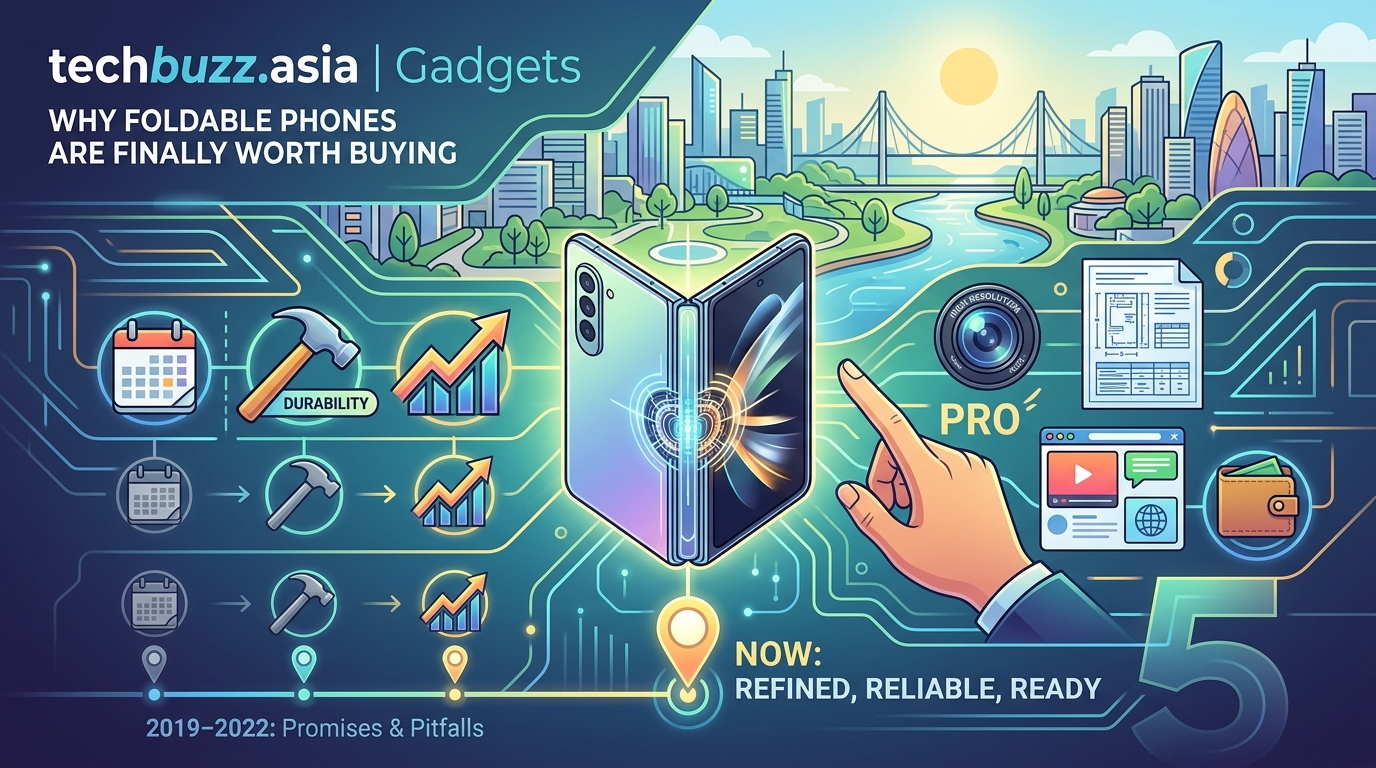
Foldables aren’t just about having a bigger screen. They change how you use your phone throughout the day.
The most obvious benefit is screen real estate. Unfolding a phone gives you roughly 7.6 inches of display, comparable to an iPad mini. Reading documents, editing spreadsheets, and reviewing photos becomes genuinely easier. You’re not squinting at tiny text or constantly zooming in and out.
Multitasking transforms from annoying to practical. You can watch YouTube while texting. You can reference a recipe while setting a timer. You can compare prices across websites without constantly switching tabs. Three-app split screen actually works on a foldable. On a regular phone, it’s a gimmick.
The cover screen serves as your normal phone for simple tasks. Checking notifications, replying to messages, and controlling music don’t require unfolding. This saves battery and means you’re not constantly opening and closing the device for trivial actions.
Foldables also replace multiple devices. If you carry both a phone and a tablet, a foldable can do both jobs. That’s one less thing to charge, update, and keep track of. For travelers or minimalists, that consolidation has real value.
Camera versatility improves too. You can prop the phone at various angles for time-lapse videos or group photos. The main cameras become selfie cameras when the phone is folded, giving you much better image quality than typical front-facing sensors.
“The moment foldables clicked for me was during a flight. I could read a full magazine layout, take notes on the side, and reference my calendar, all without switching devices or losing my place. That’s when I realized this wasn’t just a gimmick.” – Tech reviewer who switched to foldables in 2024
The downsides nobody mentions in reviews
Foldables have improved, but they’re not perfect. Some compromises are unavoidable given the form factor.
Weight is the first thing you notice. The Galaxy Z Fold 6 weighs 239 grams. The iPhone 15 Pro Max weighs 221 grams. That 18-gram difference doesn’t sound like much, but you feel it in your pocket and hand after extended use. Foldables are thick when closed too, creating a noticeable bulge in tight pockets.
Battery life suffers because you’re powering a much larger display. Most foldables struggle to make it through a full day of heavy use. You’ll want to carry a charger or power bank. This contradicts the whole “replace multiple devices” pitch when you’re constantly hunting for outlets.
Durability has improved, but foldables remain more fragile than traditional phones. The screen still uses a softer material than standard glass. It scratches more easily. You can’t use a regular screen protector on the main display. Most people use cases, but cases add even more bulk to an already thick device.
The crease is permanent. You see it. You feel it when swiping. Some people stop noticing after a week. Others never get used to it. There’s no way to know which camp you’ll fall into without trying one.
App optimization remains inconsistent. Major apps like Gmail, YouTube, and Chrome work great. Smaller apps and games often don’t take advantage of the larger screen. You end up with a phone-sized app surrounded by black bars, wasting the extra space you paid for.
Repair costs are astronomical. Replacing a foldable screen can cost $500 to $600, even with manufacturer protection plans. Drop protection is limited because cases can’t fully protect the hinge mechanism. If you’re hard on phones, factor in potential repair costs.
Similar to concerns about why your smartphone battery degrades faster than it should, foldables face accelerated wear on moving parts that traditional phones don’t have.
Who should actually buy a foldable phone right now
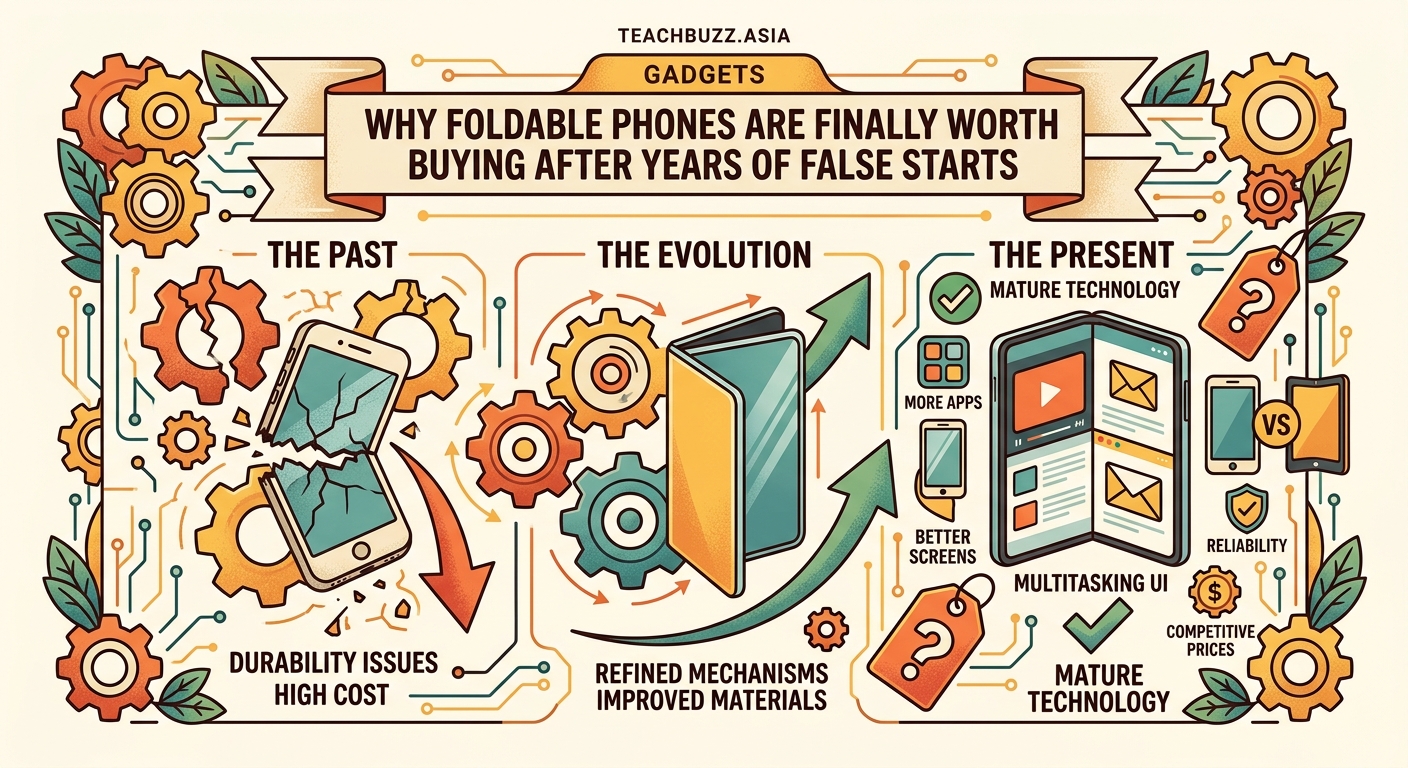
Foldables make sense for specific use cases. If you fall into one of these categories, the premium might be justified.
Power users who multitask constantly: If you regularly juggle multiple apps, reference documents while writing emails, or manage complex workflows on your phone, the extra screen space pays dividends. You’re not just getting a bigger display. You’re getting a more capable computer in your pocket.
Media consumers: People who watch videos, read ebooks, or browse social media for hours daily will appreciate the larger canvas. The difference between watching Netflix on a 6.2-inch screen versus a 7.6-inch screen is more significant than the numbers suggest.
Frequent travelers: If you’re often on planes, trains, or waiting in airports, a foldable replaces both your phone and tablet. That’s one less device to pack, charge, and carry through security. The weight penalty matters less when it eliminates another device entirely.
Early adopters with disposable income: If you love new technology and can afford to replace a phone if something goes wrong, foldables offer a genuinely different experience. Just understand you’re paying a premium to be on the cutting edge.
Professionals who present or share content: The ability to unfold your phone and show presentations, portfolios, or documents to clients or colleagues in a larger format has practical business value. The flex mode for hands-free video calls is useful for remote workers too.
Who should stick with traditional phones
Foldables aren’t for everyone. These groups are better served by conventional smartphones.
Budget-conscious buyers: You can get a flagship traditional phone with better cameras, longer battery life, and faster performance for $800 to $1,000. That same money buys you a mid-tier or older-generation foldable with compromises. Unless you specifically need the folding screen, regular phones offer better value.
People who prioritize durability: If you work in construction, spend lots of time outdoors, or have kids who grab your phone, a traditional phone with a good case is more practical. Foldables are tougher than they used to be, but they’ll never match the ruggedness of a standard slab phone.
Minimalists who want simplicity: Foldables add complexity. Two screens. A hinge. More settings to configure. More things that can break. If you want a phone that just works without thinking about it, traditional phones are still the better choice.
Heavy photographers: While foldable cameras have improved, the best camera phones are still traditional flagships. The iPhone 15 Pro, Pixel 8 Pro, and Galaxy S24 Ultra all outperform foldables in photography. If camera quality is your top priority, you’re better off with a standard phone.
Anyone keeping phones for 4+ years: Foldables are too new to know how well they age. The hinge mechanism and folding screen introduce wear points that traditional phones don’t have. If you typically use phones until they die, the safer bet is a conventional flagship with a proven track record.
How to decide if a foldable fits your actual needs
Making this decision requires honest self-assessment. Here’s a practical framework.
-
Track your current phone usage for one week. Note when you wish you had a bigger screen. Count how often you switch between apps. Identify moments where you pull out a tablet or laptop for tasks your phone can’t handle comfortably. If these situations are rare, a foldable won’t change your life.
-
Visit a store and spend 30 minutes using a foldable. Don’t just unfold it and fold it back. Actually use it. Open multiple apps. Watch a video. Browse the web. Send messages. Feel the weight. Notice the crease. Check if the thickness bothers you in your pocket. Hands-on time reveals issues that specs and reviews can’t.
-
Calculate the real cost over two years. Factor in the purchase price, potential repairs, insurance, and resale value. Compare that to a traditional flagship. Decide if the difference is worth it for your specific use case. Remember that foldables depreciate faster than conventional phones.
-
Consider your ecosystem. If you already own a tablet, laptop, and smartwatch, adding a foldable might be redundant. If you’re trying to minimize devices, a foldable that replaces your phone and tablet makes more sense financially and practically.
-
Test your tolerance for compromise. Foldables require accepting trade-offs in battery life, weight, and durability. If any of these compromises feel like deal-breakers during your testing, trust that instinct. The novelty of a folding screen wears off. The daily annoyances don’t.
When evaluating durability concerns, consider reading about what happens when tech giants stop supporting your device to understand long-term ownership implications.
Common mistakes people make when buying foldables
These errors lead to buyer’s remorse and expensive lessons.
| Mistake | Why it happens | How to avoid it |
|---|---|---|
| Buying based on novelty alone | The folding mechanism is impressive in stores | Use the phone for real tasks for 30+ minutes before buying |
| Underestimating the bulk | Specs don’t convey how thick folded phones feel | Carry a demo unit in your pocket for an hour |
| Ignoring app compatibility | Assuming all apps work perfectly on larger screens | Check if your most-used apps support foldable layouts |
| Skipping insurance | Thinking improved durability means repairs won’t happen | Always get manufacturer or carrier insurance for foldables |
| Choosing last year’s model to save money | Older foldables had significant durability issues | The improvements in recent generations justify paying more |
| Not testing the cover screen workflow | Focusing only on the unfolded experience | Ensure the cover screen is usable for your common tasks |
The actual price breakdown in 2026
Understanding the total cost of ownership helps make informed decisions.
New flagship foldables range from $1,799 to $1,999. That’s the starting price for models like the Galaxy Z Fold 6 or Pixel Fold 2. Previous-generation models drop to $1,200 to $1,400 when new versions launch.
Refurbished foldables offer better value. You can find year-old models for $900 to $1,100 through manufacturer certified programs. These typically include warranties, though shorter than new devices.
Insurance adds $15 to $20 per month through carriers, or $200 to $300 for manufacturer protection plans. Given repair costs, this isn’t optional. Budget for it.
Trade-in values help offset costs. A two-year-old flagship phone might fetch $300 to $500 in trade-in credit. That brings the effective price of a new foldable down to $1,300 to $1,500.
Resale values for foldables drop faster than traditional phones. A one-year-old foldable loses 40% to 50% of its value. Traditional flagships lose 30% to 35%. This matters if you upgrade frequently.
Accessories cost more too. Cases run $50 to $80 for quality options. Screen protectors for the cover display cost $30 to $40. You’ll want a good charger and cable since battery life requires more frequent charging.
Total two-year cost of ownership for a new foldable, including insurance and accessories, runs around $2,200 to $2,500. A comparable flagship traditional phone costs $1,500 to $1,800 over the same period.
Software features that make or break the experience
Hardware gets the attention, but software determines whether foldables are practical or frustrating.
Taskbar and app continuity: The best foldables let you pin favorite apps to a taskbar that appears when unfolded. Apps should seamlessly transition from the cover screen to the main display without restarting or losing your place. This works well on Samsung and Google foldables now, but it was broken on early models.
Flex mode support: When partially folded, the phone should automatically adjust app layouts. Video players move controls to the bottom half. Cameras show the viewfinder on top and controls on bottom. Not all apps support this, but it’s genuinely useful when they do.
Multi-window gestures: You should be able to open apps side-by-side with simple gestures. Dragging an app from the taskbar or edge panel should instantly create a split screen. If this requires diving into menus, you won’t use it.
Cover screen functionality: The external display needs to handle most common tasks without unfolding. Replying to messages, controlling music, checking weather, and taking photos should all work on the cover screen. Otherwise, you’ll constantly unfold the phone and drain the battery.
App optimization settings: Good foldable software lets you force apps to use the full screen or keep them in phone aspect ratio. Some apps look terrible stretched to tablet size. Having control over this prevents frustration.
Desktop mode: Some foldables can connect to monitors and run a desktop-like interface. This turns your phone into a portable computer. It’s a niche feature, but valuable for people who travel frequently and don’t want to carry a laptop.
Making the switch from a traditional phone
If you decide to buy a foldable, these steps make the transition smoother.
-
Start with the cover screen for one week. Use the foldable exactly like your old phone. Only unfold it when you genuinely need more screen space. This helps you identify which tasks actually benefit from the larger display versus which are just novelty.
-
Set up your multitasking workflow. Pin your three most-used app combinations to shortcuts. For example, messages plus calendar, email plus browser, or notes plus reference documents. Having these ready to launch makes multitasking practical instead of cumbersome.
-
Adjust your carrying habits. Foldables don’t fit in all pockets comfortably. Figure out which pockets work and whether you need to change how you carry your phone. Some people switch to bags or belt clips.
-
Recalibrate your charging routine. You’ll need to charge more frequently. Set up wireless chargers at your desk and bedside. Keep a cable in your bag. Adjust your habits before the low battery anxiety kicks in.
-
Install a good case immediately. Don’t wait. The phone is too expensive and fragile to use naked, even for a day. Get a case that protects the hinge and edges without adding excessive bulk.
Proper device care extends to all your tech, similar to strategies for how to maximize battery life on your iPhone in 2026, which apply to managing any premium device.
The future of foldable phones and what to expect
Foldables will continue improving, but the core concept is established. Here’s what’s coming.
Prices will keep dropping. As production scales and competition increases, expect flagship foldables to hit $1,500 in the next year or two. Mid-range foldables under $1,000 are already appearing in Asian markets and will reach the US soon.
Durability will improve incrementally. Screens will become more scratch-resistant. Hinges will last longer. But physics limits how tough a folding screen can be. Don’t expect foldables to ever match traditional phones for ruggedness.
Battery technology needs to catch up. Until we get significantly better battery density, foldables will continue struggling with endurance. Faster charging helps, but it’s not a complete solution.
Form factors will diversify. We’re seeing flip-style foldables that fold vertically instead of horizontally. Rollable phones that extend instead of fold are in development. Triple-fold devices that open into even larger screens exist as prototypes.
App support will become universal as foldables gain market share. Developers will optimize for folding screens by default rather than treating them as edge cases. This will happen gradually as foldable sales grow.
The question of whether to buy a foldable will shift from “does it work” to “is it worth the premium” as the technology matures. We’re already at that transition point.
What the choice really comes down to
Foldables work now. They’re durable enough for daily use. Software has matured. Prices, while still high, are dropping.
The question isn’t whether foldable phones are worth it in general. It’s whether they’re worth it for you specifically.
If you constantly wish your phone screen was bigger, if you juggle multiple apps throughout the day, if you consume lots of media on your phone, a foldable solves real problems. The premium makes sense.
If you’re happy with your current phone’s screen size, if you prioritize battery life and durability, if you keep phones for many years, traditional phones remain the better choice. The technology is impressive, but impressive doesn’t mean necessary.
The honest answer is that most people don’t need a foldable. But the people who do need one will find the experience transformative. The key is figuring out which group you’re in before spending $1,800.
Try one in person. Use it for real tasks. Check if the benefits outweigh the compromises. Trust your gut more than reviews or specs. Your daily experience matters more than what looks good in videos.
Foldables have finally reached the point where they’re worth considering. Whether they’re worth buying depends entirely on how you use your phone.

Post Comment