Still Swapping SIM Cards When Traveling Asia on Your Android Phone?
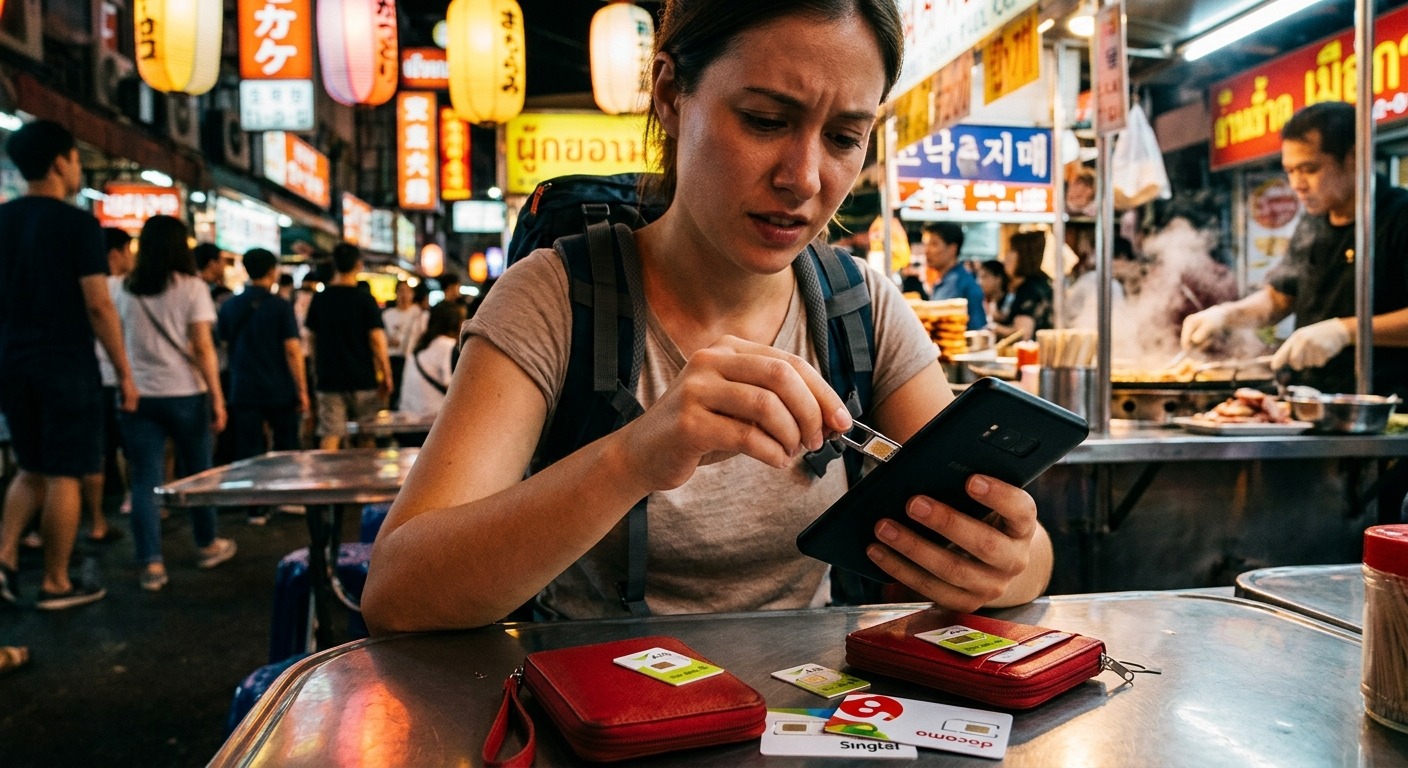
You land at Suvarnabhumi at midnight. Your home carrier kicks in, and within thirty seconds you’re staring at a roaming charge that costs more than your airport taxi. Somewhere past immigration there’s a SIM kiosk. You just don’t know which queue it belongs to, whether they accept card payments, or how long the wait will be at 1 a.m. This is a routine that frequent Asia travelers know intimately, and it hasn’t changed much in twenty years. What has changed is the technology already sitting inside your Android phone.
eSIM lets Android travelers carry local carrier profiles for multiple countries without touching a physical SIM card.
- Flagship Android phones from Samsung, Google, and Sony released since 2021 mostly include eSIM support, including many Asia-Pacific model variants.
- Major carriers across Japan, South Korea, Singapore, and Thailand now offer eSIM activation for both residents and tourists.
- You can purchase and download a local data profile before your flight boards, so your phone connects the moment the plane touches down.
The Real Cost of the Airport SIM Card Scramble
Think about what you actually go through every time you cross a border in Asia. Bangkok to Tokyo. Singapore to Seoul. Each hop means a different SIM, a different data plan, a different PIN code, and a small pile of plastic you inevitably lose at the bottom of your bag.
Skip the kiosk and rely on roaming, and the bills get ugly fast. Data roaming in Japan from a Thai carrier can run several times what a local plan would cost. In South Korea, roaming rates from Singapore carriers are not much friendlier. A single week of travel can quietly add fifty to a hundred dollars in charges you never budgeted for.
There’s also the everyday annoyance that goes beyond money. You eject your home SIM to slot in a local one. Suddenly your regular number goes dark for anyone trying to reach it. Two-factor authentication texts stop arriving. Calls from family land on voicemail. A physical SIM swap is not just inconvenient; it temporarily disconnects you from your digital identity, and piecing things back together at your destination takes time you rarely have.
What eSIM Actually Is and How It Works
An eSIM, short for embedded SIM, is a chip soldered directly into your phone’s motherboard. Unlike the plastic nano-SIM in your tray, it cannot be physically swapped out. Instead, it stores downloadable carrier profiles. You load a profile from a carrier over the internet, and your phone behaves exactly as if that SIM card were physically inserted.
The technology is built on a global standard developed by the GSMA, the industry body that coordinates mobile network interoperability. Their published embedded SIM specification defines how profiles are issued, transferred, and deleted across compatible devices. In practice, what this means for a traveler is that a single phone can hold profiles from multiple carriers at once, and you switch between them entirely in software.
An eSIM profile contains everything a carrier needs to authenticate you: your assigned number, your data entitlement, and your credentials. Download it, activate it, and your phone registers on that carrier’s network. Delete it when the trip ends. No tray. No ejector tool. No fumbling in a dim hotel room.
Which Android Phones Support eSIM
eSIM support on Android varies by manufacturer, model, and sometimes region. The short answer: if you bought a flagship Android phone in the last three to four years, there is a good chance eSIM hardware is already inside.
Samsung’s Galaxy S and Z series phones have shipped with eSIM support since the Galaxy S20 generation. The Galaxy S23, S24, and Z Fold series all support dual SIM with eSIM. Google’s Pixel lineup has been eSIM-capable since the Pixel 3, and the Pixel 7 and 8 series work reliably across Asia-Pacific networks. Sony’s Xperia 1 and Xperia 5 series, popular in Japan, also carry eSIM hardware. Devices from OPPO, OnePlus, and Xiaomi have added it in their premium tiers, though support is patchier across budget models.
One catch for buyers in Asia-Pacific: certain phones sold in specific markets shipped with eSIM disabled or removed entirely. Historically, some Chinese market variants of Samsung and Xiaomi phones stripped eSIM to comply with local regulations. Always verify your exact model number against a carrier’s supported device list, not just the phone’s commercial name, before assuming the feature is present.
Asia-Pacific Carrier eSIM Availability at a Glance
| Carrier | Country | eSIM Support | Tourist Plans |
|---|---|---|---|
| NTT Docomo | Japan | Yes | Limited |
| SoftBank | Japan | Yes | Yes |
| SK Telecom | South Korea | Yes | Yes |
| KT (Korea Telecom) | South Korea | Yes | Yes |
| Singtel | Singapore | Yes | Yes |
| StarHub | Singapore | Yes | Yes |
| AIS | Thailand | Yes | Yes |
| True Move H | Thailand | Yes | Yes |
| Telkomsel | Indonesia | Yes | Limited |
| Maxis | Malaysia | Yes | Limited |
Tourist-focused eSIM plans from third-party providers fill the gap where carrier-direct options are thin. A regional Asia plan from one of these providers often covers Thailand, Singapore, Japan, and South Korea under a single purchase, which suits a multi-stop itinerary without any extra fiddling between countries.
Getting Your Profile Loaded Before You Board
This is the part most travelers miss entirely. You can buy and activate an eSIM profile while still at home, sitting on your couch with reliable Wi-Fi. You do not need to be in the destination country. You do not need to find a physical store.
The process is straightforward on most Android devices. Head into your phone’s network or connections settings and find the SIM management section. From there, you add a new eSIM. After purchasing a plan, the carrier sends a QR code by email. Scan it, and the profile downloads directly to your device. It sits there ready to activate, while your home SIM continues running in the other slot.
A step-by-step walkthrough of the android eSIM install process is worth reading before your trip, since the exact menu path differs between Samsung One UI, Google’s stock Android, and other manufacturer skins. Knowing where to go in advance means no fumbling through settings menus at a departure gate with twenty minutes until boarding.
Timing matters here. Download and activate the profile while on home Wi-Fi. Some eSIM profiles need a data connection to complete the activation handshake. If you wait until the plane lands to start the process, you may end up relying on airport Wi-Fi to get online, which partially defeats the point.
Things to Double-Check Before Every Border Crossing
Even with eSIM fully set up, a few variables can still trip you up. Run through these before each trip:
- Your phone is carrier-unlocked. Phones purchased on a carrier contract may be locked to that operator’s network. Factory-unlocked or carrier-unlocked devices work with any eSIM profile without restriction.
- Your specific model variant supports eSIM. Not every variant of a phone does. Cross-reference your exact model number against the carrier’s or provider’s supported device list, not just the phone’s marketing name.
- The plan covers your actual destinations. Regional eSIM plans often have caveats buried in the fine print. A Southeast Asia bundle might include Thailand and Singapore but exclude Japan. Read the coverage details before purchase, not after arrival.
- The profile hasn’t expired. Many prepaid eSIM profiles carry validity windows from the purchase date, not the activation date. A plan bought months ago for a postponed trip may have already lapsed before you board.
- You have a fallback ready. eSIM provisioning occasionally fails. Servers go down, QR codes scan incorrectly, or profile downloads time out. Keep your physical SIM accessible, or locate the nearest carrier store at your destination in advance.
Drop the Plastic: Why Asia Frequent Flyers Are Moving to eSIM
The shift happening among frequent Asia travelers is a practical one, not a gadget enthusiast trend. People who regularly hop between Bangkok, Tokyo, Seoul, and Singapore have simply done the math. The roaming charges, the kiosk queues, the juggled SIM trays, and the scattered tiny plastic cards add up in time and money across a year of travel. eSIM removes most of that friction in one clean move.
Carriers across Asia-Pacific have responded. The rollout of tourist-friendly eSIM plans accelerated sharply over the past two years, particularly in Japan, South Korea, and Singapore, where inbound tourism volume makes the investment worthwhile. Indonesia and Malaysia are gaining ground, with Telkomsel and Maxis both expanding their eSIM infrastructure for consumer use.
The remaining gap is not technology. It’s awareness. Many travelers have not tried eSIM simply because no one told them their phone already supports it. If you’re carrying a Galaxy S21 or newer, a Pixel 6 or newer, or a recent Xperia flagship, eSIM hardware is almost certainly already inside your device, unused and waiting.
The next time flights from Bangkok to Tokyo or Singapore to Seoul go into the cart, set aside twenty minutes to sort out connectivity before departure. Purchase the regional eSIM plan, scan the QR code, confirm the profile is downloaded, and it’s done. The kiosk queue at Narita or Changi can belong to someone else.

Post Comment