Why Tech Companies Are Investing Heavily in On-Device AI Processing
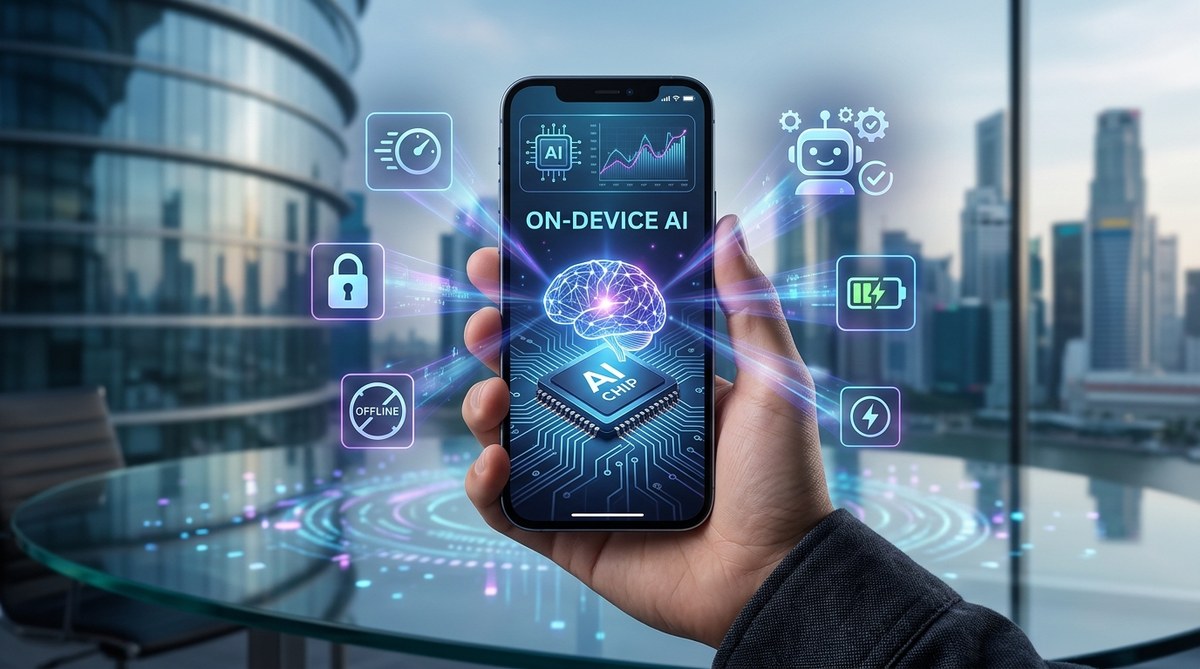
For a long time, artificial intelligence was something that happened in a faraway data center. You sent a request, it went to the cloud, got processed on a powerful GPU, and the result came back to you. That model worked well for search and chatbots. But in 2026, that architecture is showing serious cracks. The biggest players in technology are now steering their entire product roadmaps toward running AI directly on your smartphone, laptop, tablet, and car. This isn’t just a trend. It is a fundamental shift in computing strategy driven by real economic and practical pressures.
Tech companies are pouring resources into on-device AI to solve three core problems: cloud latency, rising inference costs, and user privacy concerns. In 2026, specialized chips like Apple’s Neural Engine and Qualcomm’s Hexagon NPU make local inference possible on billions of devices. This shift allows for faster, more personal, and always-available AI experiences that respect user privacy, fundamentally changing how software is built, deployed, and monetized.
Real-Time Applications Need Local Speed
Latency is the enemy of good user experience. If you are using an augmented reality navigation app, a delay of even 200 milliseconds can make the difference between feeling like magic and feeling broken. The same goes for real-time voice translation, autonomous driving, or an AI assistant that can see your screen. Sending data to the cloud and waiting for a response simply takes too long.
On-device AI processing eliminates the round trip entirely. The model runs directly on the chip inside the device. Inference times drop to milliseconds. This makes entirely new categories of software possible. For example, a camera app that can identify an object and adjust settings instantly, or a piano app that listens and gives feedback on your fingering in real time, only works if the processing is local. Companies know this. If they want to deliver the next generation of “ambient” computing smart glasses, contact lenses, or always-on earbuds they have to solve the latency problem. The only viable solution is to put the AI on the device itself.
Privacy Becomes a Competitive Moat
Data privacy is no longer just a compliance checkbox. It is a major selling point. Consumers have become much more aware of what happens to their photos, messages, and voice recordings when they are sent to the cloud. The backlash against centralized data collection has pushed companies to look for alternatives.
On-device AI offers a powerful promise: your data never has to leave your phone. Health data, facial recognition data, and personal writing can be processed entirely on the device. Apple has been championing this approach for years, and Google followed suit with its Tensor chips and Pixel phones. Samsung’s Galaxy AI features heavily rely on local processing for tasks like live translate and photo editing.
This is a direct response to the privacy regulations in the United States and Europe. By processing data locally, companies avoid the risk of a cloud breach and the cost of compliance. They also gain the trust of users. In a world where data leaks are common, marketing a device that “knows you without spying on you” is a powerful advantage. That is why we see huge marketing budgets tied to this specific capability.
The Cloud Cost Crisis
Let’s talk about money. Running large language models and generative AI in the cloud is incredibly expensive. Every single query costs a company a fraction of a cent in compute and electricity. When a product goes viral and gets millions of users, those fractions of a cent add up to millions of dollars in cloud bills.
On-device AI processing inverts this economic model. The user owns the hardware, and the user pays for the electricity. When a model runs locally, the company pays nothing for the inference. This is a massive shift in the unit economics of software.
Think about a feature like “Magic Eraser” in Google Photos or Apple’s “Clean Up” tool. If every single user ran that AI workload on a cloud server hundreds of times a day, the cost would be astronomical. By running it on the device’s NPU, the cost to Google and Apple drops to near zero. This allows them to offer powerful AI features for free, which drives hardware sales and ecosystem lock-in.
This economic reality is the single biggest driver of the on-device AI processing investment. Companies are betting that putting a more expensive chip in the phone today is cheaper than paying NVIDIA for cloud inference for the next five years. It is a simple long term financial calculation. For a deeper look at how these workloads affect your phone’s health, check out Why Your Smartphone Battery Degrades Faster Than It Should.
How On-Device AI Actually Works
Getting a massive AI model to run on a tiny phone battery requires some serious engineering tricks. It is not as simple as copying a file. Here are the three primary techniques companies are using to make this happen:
-
Model Quantization. This shrinks the size of the AI model by reducing the precision of its numbers. Instead of using 32-bit floating point numbers, the model uses 8-bit or even 4-bit integers. This dramatically reduces the memory footprint and speeds up computation, with only a small drop in accuracy.
-
Knowledge Distillation. Think of this as a teacher-student relationship. A massive “teacher” model (like GPT-4) generates training data for a much smaller “student” model. The student learns to mimic the teacher’s behavior, but it is a fraction of the size and can run locally.
-
Hardware-Specific Optimization. Companies like Apple, Qualcomm, and Samsung have their own software frameworks (Core ML, Qualcomm AI Engine, etc.). These frameworks adapt the AI model specifically to the hardware, using the neural processing unit (NPU) and GPU in the most efficient way possible.
These techniques are why we can now see powerful language models running on devices with just 8GB of RAM. It is a combination of clever software and specialized hardware.
The Hardware Gold Rush
The performance of these local AI models depends entirely on the chip inside the device. Here is a snapshot of the major players and their NPU capabilities in 2026.
| Company | Key Chip / Platform | AI Engine Name | Peak Performance | Primary Focus Area |
|---|---|---|---|---|
| Apple | M4 / A18 Pro | 16-core Neural Engine | 38+ TOPS | System UX, Image/Video, LLMs |
| Qualcomm | Snapdragon X Elite / 8 Gen 4 | Hexagon NPU | 45+ TOPS | Generative AI, Camera, Gaming |
| Intel | Core Ultra 200V | Intel AI Boost NPU | 40+ TOPS | PC Copilot+ Experiences |
| Tensor G5 | Edge TPU | 20+ TOPS | Pixel Photography, Speech/Text | |
| AMD | Ryzen AI 300 Series | XDNA 2 NPU | 50+ TOPS | Productivity, Content Creation |
These numbers matter because operating systems like Windows and macOS are beginning to require a minimum NPU performance to enable certain features (like Microsoft’s Copilot+). The race is on to pack as much AI compute into the device as possible. The idea that Why Your Next Laptop Will Have a Dedicated AI Coprocessor is already a reality.
The Challenges Ahead
Despite all the progress, on-device AI is not a perfect solution. It comes with its own set of problems.
“The biggest hurdle is no longer raw hardware performance. It is fragmentation and the memory wall,” says Dr. Anya Sharma, lead analyst at Silicon Strategies Group. “You can have a 50 TOPS NPU, but if the bandwidth isn’t there, or the developer tools are immature across different vendors, the ecosystem struggle remains. Models that run well on an iPhone need significant tweaking to run on a Galaxy or a Pixel.”
Developers face a tough landscape. They must optimize their models for several different chip architectures. On top of that, running a large model continuously can still drain the battery, even with an NPU. Manufacturers have to balance performance with thermal output. Nobody wants a phone that gets hot just because they used an AI filter. As a consumer, it is important to know how to cut through the buzzwords, and How to Spot Fake Tech Reviews Before Making Your Next Purchase is a useful skill now more than ever.
Opportunities for Users and Developers
So, what does this all mean for the person buying the device?
- Smarter, Faster Assistants. Your phone assistant can finally understand context without needing a data connection. It can process your schedule, emails, and documents locally to give you personalized help instantly.
- Real-Time Creativity. Tools like generative fill, music creation, and video editing that used to take hours of rendering now happen as you move a slider. The creative flow is no longer interrupted by loading bars.
- New Accessibility Features. Real time sign language recognition, scene descriptions for the blind, and voice cloning for people with speech impairments all become practical because they work offline and privately.
- Developer Opportunities. The shift is similar to the early days of the App Store. Apps that utilize on-device AI are seen as more premium and private. Developers who master frameworks like CoreML, TensorFlow Lite, and ONNX Runtime will have a massive advantage over the next decade.
This technology is also a big part of the broader landscape outlined in 5 Emerging Technologies That Will Change How We Work by 2026. The ability to work offline with a fully capable AI assistant is a game changer for remote workers and travelers.
The Shift From Cloud to Edge
This is not to say the cloud is dead. Far from it. The cloud will still handle heavy lifting training the giant models, storing data, and running complex multi-step reasoning. What we are seeing is a hybrid model. Simple, latency-sensitive, and private tasks stay on the device. Complex, one-off tasks get sent to the cloud.
This is reminiscent of how we think about computing today. No one runs a web browser on a mainframe anymore. We use local computers. The same is happening with AI. The “AI computer” is your phone, your laptop, and your car.
Companies that bet early on this trend like Apple and Qualcomm are now well positioned. Companies that relied entirely on cloud AI are scrambling to catch up. It represents a massive shift in where value is captured in the tech stack. If hardware is the platform for AI, then the chip maker and the device maker have the most power.
As we saw with the early adoption of new display types, hardware innovation eventually meets software maturity. Much like Is Foldable Technology Finally Ready for Mainstream Adoption?, on-device AI is making the jump from a neat party trick to a daily essential.
The key takeaway for investors and professionals is that the infrastructure for AI is no longer just about server farms. It is about the 5 billion devices in people’s pockets. Understanding this shift helps predict which companies will grow in the coming years. The winners will be the ones who make AI invisible, instant, and private. And that happens right at your fingertips.

Post Comment