Stop Getting Stomped: How to Master Movement Mechanics in Modern Shooters
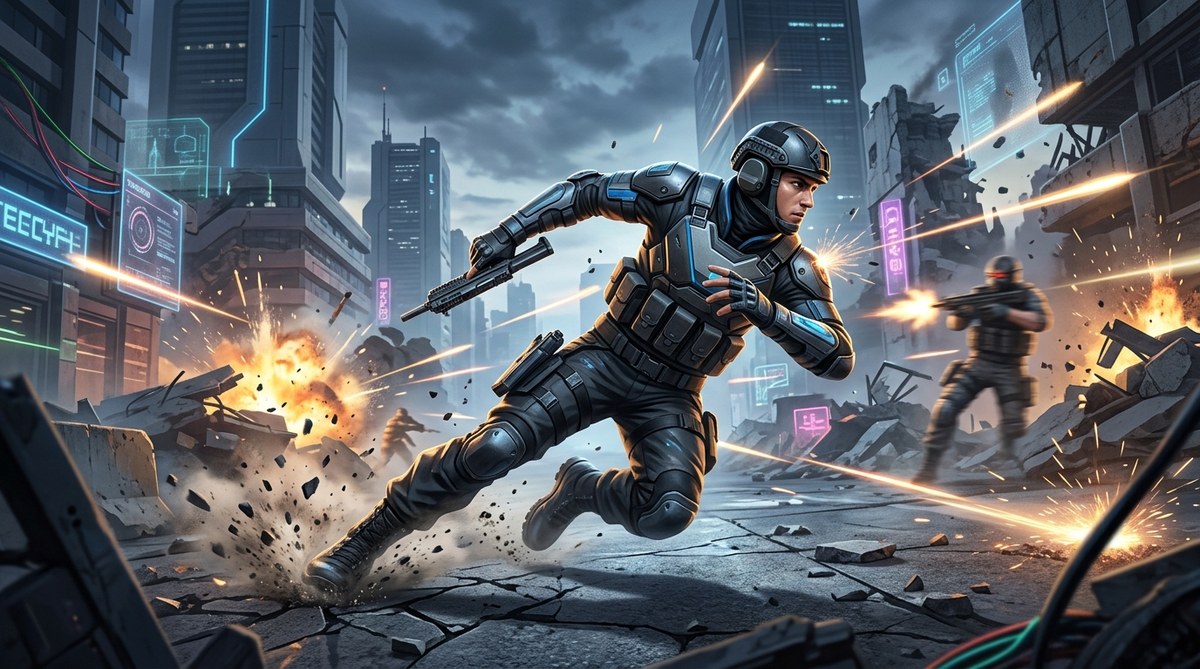
You land hot, grab your favorite gun, and then it happens again. Some player slides past you, jumps over your crosshair, and lands every shot while you are still trying to track them. You know your aim is decent. You practice in the firing range. But in real matches, you feel like you are stuck in mud. The difference is not just aim. The difference is understanding the underlying movement mechanics in modern shooters. These systems are not random. They follow rules about momentum, acceleration, and timing. Once you learn those rules, you stop being a target and start being the one who controls the fight.
Movement in modern shooters is a skill you can learn, not a talent you are born with. By focusing on three core principles (momentum control, input optimization, and map geometry awareness) you can win more fights. This guide breaks down the mechanics behind slide-canceling, strafing, and air-strafing so you can practice with purpose.
What Makes Movement Feel Different in 2026
Every major shooter today uses a unique movement system. Apex Legends relies on a source-engine based physics model that rewards momentum. Call of Duty uses an arcade-style system with strict limits on slide velocity. Overwatch leans on ability-based mobility tied to cooldowns. The common thread is that all of them punish standing still.
If you stand still to shoot, you are an easy target. The best players use movement to make themselves harder to hit while maintaining accuracy. This is not about bunny hopping in circles. It is about understanding how your character model interacts with the game world.
There are three main pillars that define movement mechanics in modern shooters:
- Momentum preservation: How the game keeps your speed when you change direction or actions.
- Input latency: The delay between your command and the character’s response, affected by your hardware.
- Animation cancels: Actions that let you skip recovery frames to move faster than intended.
The Three Core Principles You Need to Know
1. Momentum Preservation
Think of momentum as a bank. When you sprint, you deposit speed. When you slide, you withdraw it. When you jump, you spend it in the air. The trick is learning how to keep that speed when you need to shoot or change direction.
In Apex Legends, slide-canceling works because the game does not reset your velocity when you jump out of a slide. You maintain your forward momentum while gaining the ability to redirect your aim. In Call of Duty, the system is stricter. You lose momentum faster, which is why slide-canceling there is more about breaking camera angles than maintaining speed.
2. Input Optimization
Your controller or mouse settings are part of the movement equation. High sensitivity is useless if you cannot control micro-adjustments. Low sensitivity protects your aim but limits your ability to turn on enemies.
For controller players, the right response curve matters more than the sensitivity number. Linear response curves give you direct 1:1 input, which helps with precise strafing. Dual-zone curves let you aim slow in the center and fast at the edges. If you play on a standard console controller, check your stick deadzones. A deadzone that is too high kills your ability to make small corrections while strafing.
3. Map Geometry Awareness
Movement does not exist in a vacuum. Every wall, slope, and piece of cover changes how your character behaves. Sliding downhill gives you extra distance. Jumping off a ledge cancels your sprint recovery. Understanding the map layout lets you plan movement paths instead of reacting to enemies.
A Step-by-Step Process to Improve Your Movement Today
You do not need to grind for hours in the training mode. Use this five-step process to build better habits.
-
Set your sensitivity to a linear curve (if available) and lower your deadzone to 5% or less. Test it in the firing range. If you cannot track a moving target smoothly, raise the deadzone slightly.
-
Practice the sprint-slide-jump combo on flat ground. Sprint for two steps, slide, then jump at the end of the slide. Focus on keeping your crosshair at head height during the entire sequence.
-
Add a directional change. After the jump, air-strafe by holding a direction key (or tilting the left stick) and moving your mouse or right stick in the same direction. This changes your trajectory without losing speed.
-
Incorporate a wall bounce. In games that allow it (Apex, Titanfall 2), run at a wall at a 45-degree angle, jump, and look away from the wall to redirect your momentum. This is not just a trick. It is a core survival tool for escaping bad fights.
-
Take it into a real match. Commit to using movement in every engagement. Do not worry about winning. Focus on making yourself hard to hit. The kills will follow.
Common Movement Mistakes and How to Fix Them
| Mistake | Why It Hurts You | The Fix |
|---|---|---|
| Over-sliding | You become predictable and easy to pre-aim. | Slide only when you need to break line of sight or change elevation. |
| Crouch spamming | It kills your strafe speed and makes you an easier target at range. | Use crouch once or twice during a strafe, not repeatedly. |
| Jumping in straight lines | Your arc is predictable. | Air-strafe to change direction mid-jump. |
| Ignoring sprint recovery | You cannot shoot immediately after sprinting. | Slide or jump to bypass the recovery animation. |
| High deadzone on controller | You lose fine control for strafing. | Lower your deadzone to the smallest value that does not cause drift. |
“The best players do not just react to movement. They predict it. They know that after a slide, most players will either jump or stand up. If you learn to read those two options, you can pre-fire the jump and win the fight before it starts.” — Coach from a competitive Apex Legends team, 2026
How to Train Movement Without Burning Out
Grinding the same drill for an hour is boring and inefficient. Instead, use a varied practice routine.
- Day 1: Focus on strafing only. Stand still and practice left-right movements while shooting a stationary target. Then add a moving target.
- Day 2: Practice slide-canceling and wall bounces on a flat map like the Apex Firing Range or a custom Call of Duty lobby.
- Day 3: Combine everything in a real game. Record a few minutes of gameplay and watch it back. Look for moments where you stood still or moved predictably.
- Day 4: Rest. Let your muscle memory consolidate.
- Day 5: Repeat with a goal to reduce your “stand still” time by half.
This cycle prevents burnout and builds lasting improvement. If you want to optimize your setup further, check out our guide on how to optimize your gaming PC for maximum FPS in 2026. Smooth frames make movement feel more responsive.
Why Your Gear Matters More Than You Think
Your mouse, keyboard, or controller is the bridge between your brain and the game. A cheap mouse with a low polling rate introduces input lag that you cannot fix with settings. A standard membrane keyboard has a slower actuation point than a mechanical switch. These small delays add up. If you are serious about movement, consider investing in gear that reduces latency.
But do not rush out to buy a new setup. First, test your current gear. If you use a wireless controller, plug it in. Wireless adds 4-8ms of input lag. That might not sound like much, but in a game where fights last 1.5 seconds, it is the difference between landing your shot and missing. For more on choosing the right peripherals, read do you really need a gaming mouse if you’re not a professional gamer?
Adapting Movement to Different Game Engines
Not all shooters are built the same. Here is how to adjust your approach for the three most popular games in 2026.
Apex Legends: Movement is king. The source engine allows for air-strafing, wall bouncing, and tap-strafing (on PC). Focus on learning one advanced technique at a time. Start with slide-canceling, then add wall bounces, then air-strafing.
Call of Duty (Black Ops 7 / Modern Warfare 4): Movement is more restricted. Slide-canceling has been nerfed in recent titles. The meta now favors “movement sliding” (using slide to break angles) combined with jump shots. Do not try to bunny hop. Instead, practice jump-shotting around corners.
Overwatch 2: Movement is tied to abilities. Tracer has blink, Genji has double jump, and Lucio has wall ride. The skill is not in the movement itself but in timing it with cooldowns. Practice using movement abilities to dodge specific enemy cooldowns, not just to move faster.
Your First Week of Movement Training
Here is a concrete plan. Do not skip the warmup.
-
Warmup (5 minutes): Load into the firing range. Sprint, slide, jump, and shoot a stationary target. Repeat until the sequence feels smooth.
-
Drill 1 (10 minutes): Find a long wall. Practice wall bouncing on both sides. Aim for consistency, not speed.
-
Drill 2 (10 minutes): Play a deathmatch or team deathmatch. Your only goal is to survive longer than 10 seconds per engagement. Do not focus on kills. Focus on using movement to escape.
-
Review (5 minutes): Write down one thing that felt difficult. Address it tomorrow.
Putting It All Together
Movement mechanics in modern shooters are not a secret language reserved for pros. They are a system of rules that you can learn, practice, and apply. The players who dominate your lobbies are not genetically gifted. They have simply spent time understanding momentum, optimizing their input, and reading the map.
Start with the basics. Fix your settings. Practice the sprint-slide-jump combo. Watch your own replays. In two weeks, you will notice a difference. In a month, you will be the one sliding past enemies and landing shots while they struggle to track you. The game becomes more fun when you control your own movement. Go out there and make it happen.


Post Comment